News
For Media Inquiries please fill out this form.
T-Satellite with ATAK
March 17th, 2026
COTAK Program Team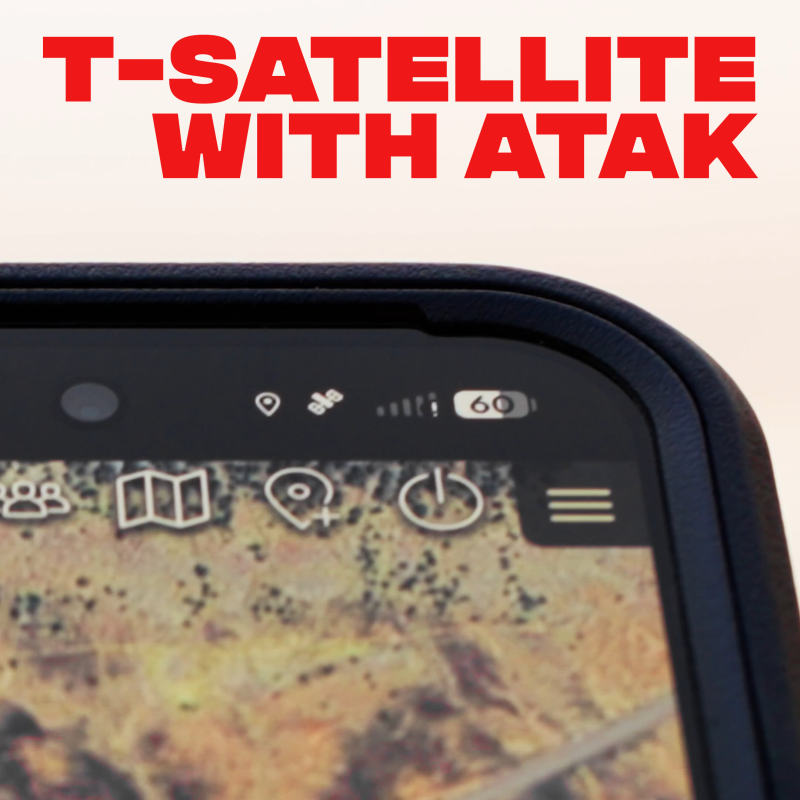
The COTAK team is frequently asked how users can use the apps to communicate in remote areas of Colorado, where cell service is spotty or nonexistent. A significant new option for these situations is cellular capabilities that enable smartphones to communicate directly with satellites overhead.
These direct-to-satellite capabilities vary widely; some, like the iPhone satellite messaging capability, rely on older communications satellites with relatively weak signals and require users to point their phones at the sky for optimal performance when sending small files like text messages.
Many other direct-to-satellite capabilities are coming online, and some use modern, innovative satellite technologies, such as phased-array antennas, to generate signals similar to those from a cell tower on the ground. This allows cell phones to function similarly to how they normally do, with support for apps that require only a small amount of bandwidth, such as TAK. While features that require a consistent connection, such as phone calls and streaming video, are still under development, these new capabilities allow apps like TAK to keep functioning as normal even when you lose connection to towers on the ground.
The first of these capabilities that the COTAK team has tested is T-Mobile’s T-Satellite service for Android phones, which enables ATAK to operate in areas without T-Mobile service. We have made a video to highlight this capability, check it out here! While this capability is currently Android-only, we expect to add iOS support soon. Similarly, while this works only on T-Mobile, other cellular carriers are quickly developing similar capabilities, and COTAK will continue to share news as this service becomes more broadly available. We invite you to read our media release below:
RIFLE, COLO. - (April 24, 2026) - The Colorado Team Awareness Kit (COTAK) program has successfully demonstrated emerging satellite direct-to-cellular (D2C) technology integrated with the Android Team Awareness Kit (ATAK). This breakthrough provides public safety agencies with an effective method to maintain vital situational awareness in regions where traditional cellular service is unavailable.
First responders in Colorado frequently encounter unreliable or nonexistent cell service in the state's vast remote areas. To address this, the COTAK team continually evaluates innovative technologies to keep responders connected during critical operations.
Recent testing centered on T-Mobile’s T-Satellite service for Android devices, which enables smartphones to establish LTE connections directly to satellites overhead, eliminating reliance on ground-based cellular towers. As a result, ATAK continues to provide a real-time map of first responder locations, even in remote, off-grid environments. “Reliable communication is essential for responder safety and mission success,” said Brad Schmidt, COTAK Program Manager. “This technology marks a major advancement, ensuring ATAK users can maintain situational awareness — even in Colorado’s most challenging and remote locations.”
Earlier satellite messaging solutions often required manual phone alignment and supported only basic text communication. In contrast, today’s D2C technologies use advanced satellite systems, such as phased-array antennas, to mimic traditional cellular networks. This improvement enables low-bandwidth applications like ATAK to work smoothly, allowing real-time location sharing and uninterrupted data exchange.
“Search and rescue operations in Western Colorado regularly take our teams into rugged, remote terrain where cellular infrastructure simply does not exist. On a recent mission responding to an SOS activation deep in a BLM area, that was exactly the environment we faced. What made the difference was the integration of TSAT with our TAK-enabled devices. Despite having zero cell service, we maintained live mapping, navigated directly to our subject and gave our Operations team full real-time visibility of both field teams from staging. The ability to sustain that level of situational awareness in a completely off-grid environment represents a meaningful advancement in how we protect both our members and the people we serve," said Nallely Bean, Board Secretary and Public Information Officer at Mesa County Search and Rescue.
Although high-bandwidth features such as voice calls and video streaming are still under development, the current generation of D2C technology is already proving valuable for mission-critical applications. COTAK’s testing confirms ATAK remains operational using T-Satellite connections, representing a significant milestone in expanding resources for first responders. While current implementation is limited to Android devices on T-Mobile’s network, similar solutions are quickly emerging on other carriers and platforms.
COTAK expects broader availability soon, including potential support for iOS devices, and will continue to evaluate and share updates as the technology evolves. To view a demonstration of ATAK operating over satellite connectivity, visit cotak.gov/pages/connectivity.
# # #
About the Center of Excellence and COTAK
Founded in 2014, the Center of Excellence for Advanced Technology Aerial Firefighting (CoE) is a premier research and development organization within the Colorado Division of Fire Prevention and Control. The CoE develops and provides the Colorado Team Awareness Kit (COTAK™), a real-time platform that displays precise location information for team members and essential mission details. This resource is available free of charge to all Colorado public safety agencies. The CoE’s mission is to advance emergency response by introducing innovative technologies and setting new standards in public safety for the benefit of Colorado communities.For more information, visit cofiretech.gov or follow us on Facebook, Instagram, X, and LinkedIn.